JEEVA
India's Intelligent Emergency Response Network
"When an accident happens, every second matters."
In severe highway collisions and remote rural incidents, victims may be unconscious, trapped, or unable to call for help. JEEVA connects approved vehicle telemetry, automated collision detection, regional emergency networks, and specialized trauma centres to preserve the Golden Hour.
How JEEVA Coordinates Live Highway Interventions
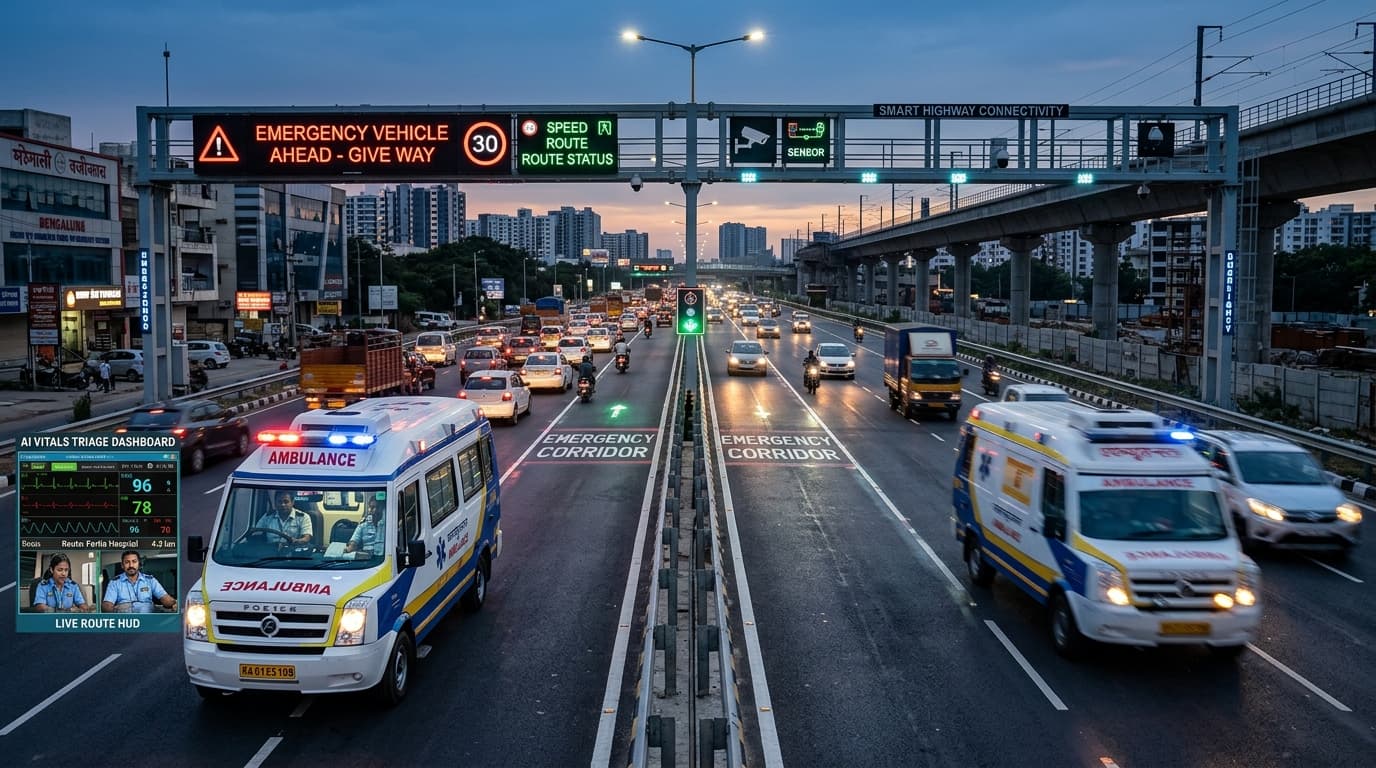
Connected emergency ambulance operating in sync with dynamic highway gantries and real-time AI vitals triage.
Automated Corridor Clearance
Smart highway displays alert traffic 2 to 3 km upstream, automatically directing civilian vehicles out of the dedicated emergency transit lane.
Pre-Hospital Vital Telemetry
Patient cardiac rhythms, oxygen levels, and shock indicators stream continuously to the destination trauma hospital before arrival.
Zero Handoff Bottlenecks
Emergency surgeons and cross-matched O-negative blood units are standing ready in the trauma bay the moment the ambulance docks.
Four Critical Friction Points in Trauma Care
Why severe highway and rural incidents result in preventable loss of life.
Analysis of the systemic bottlenecks between a physical impact event and the arrival of specialized emergency care.
Delayed Emergency Response
After a serious road accident, the victim may be unconscious, severely injured, trapped in wreckage, unable to use a mobile device, or physically unable to explain where they are. Passersby may not stop or know how to assess trauma severity. This critical reporting delay causes trauma response times to stretch from precious minutes into hours.
What If the Victim Cannot Call?
Traditional emergency response depends 100% on a conscious human dialing 112 or 108. JEEVA proposes approved vehicle-generated automated alerts triggered by on-board MCU telematics whenever high-G deceleration, rollover, or airbag deployment occurs.
Accurate Emergency Location
When callers do manage to report an accident, panic and unfamiliarity with remote bypasses or rural roads lead to vague descriptions ("near the big tree on the highway"). Ambulances wander looking for the scene. JEEVA transmits dual-band GNSS latitude, longitude, highway milestone ID, and corridor heading directly to emergency consoles.
Intelligent Hospital Coordination
The closest hospital is not always the most appropriate facility. Taking a severe neuro-trauma or cardiothoracic injury to a basic primary health clinic wastes vital minutes. JEEVA's algorithm balances distance, real-time travel duration, trauma capability (Level 1/2/3), ICU bed availability, and blood bank inventory before routing.
How JEEVA Works
The 8-stage automated emergency cascade.
A seamless, end-to-end chain connecting physical vehicle dynamics to hospital trauma bays in under 12 minutes.
VEHICLE
Equipped with approved multi-axis sensors & collision telemetry MCU.
AI CRASH DETECTION
Detects severe delta-V deceleration, rollover, or airbag igniter.
EMERGENCY ALERT
Instant automated encrypted SOS beacon broadcasted via cellular/satellite.
PRECISE LOCATION
Dual-band GNSS pinpoints exact corridor coordinates & travel direction.
EMERGENCY NETWORK
Central triage cloud parses telematics & calculates response priorities.
AMBULANCE DISPATCH
Closest advanced life-support (ALS) unit routed via green corridor.
APPROPRIATE FACILITY
Matched by trauma level, specialist availability, and surgical capacity.
EMERGENCY RESPONSE
Patient arrives with pre-allocated trauma bed, blood units, and surgical prep.
Vehicle AI & Telematics Specifications
Future commercial and passenger vehicles could integrate approved safety sensors capable of identifying serious collision indicators. Monitored telemetry signals include:
Gemini Emergency Intelligence Console
Active live simulation: Automated incident detection & dispatch command interface.
"Major collision indicators detected. High-impact event identified at State Highway 17 bypass near Sircilla. Dual airbag trigger and sudden cessation of kinetic telemetry confirm high rollover risk. Immediate trauma response is recommended. Sircilla Area Hospital matched for rapid stabilization; Karimnagar District Hospital alerted for Level-2 neuro-surgical backup."
Artificial intelligence in the JEEVA architecture serves exclusively as an advisory telematics aggregator to assist emergency professionals. AI does NOT independently make critical medical decisions, diagnose patients autonomously, or replace authorized dispatch protocols.
Trained human emergency personnel, medical officers, and licensed paramedics remain solely responsible for: clinical diagnosis, triage decisions, vehicle dispatch authorization, patient treatment, and legal emergency coordination.
Emergency Care Shouldn't Depend on Your PIN Code.
Connecting underserved rural habitations with tertiary medical networks.
A national vision to link primary healthcare clinics, rural emergency centres, GPS-routed ambulances, and specialized district hospitals into one coordinated relay.
VILLAGE / HABITATION
Local incident detected or reported via community beacon.
LOCAL EMERGENCY CENTRE
Sub-district health centre initiates rapid stabilization.
CONNECTED AMBULANCE
Telemedicine-equipped transit maintains vitals telemetry.
APPROPRIATE HOSPITAL
District trauma facility pre-allocates surgical bay.
SPECIALIST CARE
Multi-speciality tertiary network provides advanced intervention.
Golden Hour Transit Comparison
Simulate incident distance from nearest tertiary medical hub:
Affordable & Accessible Healthcare Integration
People should not lose access to essential life-saving healthcare simply because they cannot afford expensive private treatment. The JEEVA concept is architected to seamlessly interface with:
Interoperability with public welfare health missions and cashless emergency stabilisation.
Pre-authorized stabilization protocols ensuring no hospital turns away critical trauma cases.
Remote digital consultations guiding rural nurses and paramedics before tertiary transfer.
* Regulatory Notice: This document outlines an architectural integration vision. It does not claim that a new public insurance scheme or commercial insurer product currently exists.
The Healthcare Evolution Timeline
From human-dependent calls to an integrated national emergency network.
A grounded 4-phase horizon describing how India can progressively advance its emergency trauma coordination.
Human Action Dependency
Emergency calls rely entirely on conscious human dialers, verbal location descriptions, and manual triage coordination.
Connected Vehicles
Approved vehicular safety sensors dispatch automated telemetry alerts, reducing reporting lag from hours to seconds.
AI-Assisted Dispatch
Regional emergency systems parse multimodal crash telemetry and pre-allocate hospital trauma bays dynamically.
National Trauma Mesh
Unified public infrastructure integrating air, road, rural clinics, and super-specialty trauma centres nationwide.